
Paintless dent repair, or PDR, pushes a dent back out from behind the panel. No filler, no sanding, no paint. Your factory finish stays on the car, and that’s the whole point.
It’s for door dings, hail and shallow dents where the paint isn’t broken. It doesn’t work on every dent. Plenty of people call us asking for PDR when the car really needs body work.
This page shows you how to tell the two apart. If you’re not sure, ask us. We do both, so we have no reason to push you one way or the other.
PDR or body work?
Start with the paint, then look at the metal. If the paint is broken, PDR is off the table.
| What to check | Usually PDR | Usually body work |
|---|---|---|
| Paint | Intact, no chips or cracks | Cracked, chipped or scraped through |
| Dent shape | Shallow with smooth edges | Sharp, deep, or the metal is stretched |
| Location | Open part of a panel | On a sharp body line or a panel edge with no access behind it |
| Panel history | Original paint | Filler or an earlier repaint |
| What caused it | Door ding, hail, shopping cart, bicycle | A hit from another car, a pole or a wall |
| Anything else damaged | No, just the dent | Bumper, lights, trim or sensors are damaged too |
Searched PDR after an accident?
If another car hit you, take a closer look. A dent that looks small can come with cracked paint or damage you can’t see from outside. That’s a body work job and usually an insurance claim, not PDR. Call us anyway. See our collision repair page for how that works.
Why the paint decides it
PDR reshapes metal. It can’t replace paint. Here’s what each case looks like from the side.
If your panel is on the body work list, we’ll tell you and quote the conventional repair instead. When a part has to be replaced, we use new OEM parts only.
How PDR works
The work is slow and done in small moves. Rushing it is how you get a panel that looks right in the shop and wrong in daylight.
We look at it first
We check the paint, the dent and the panel, and tell you whether it’s PDR or body work before we start.
We get to the back of the panel
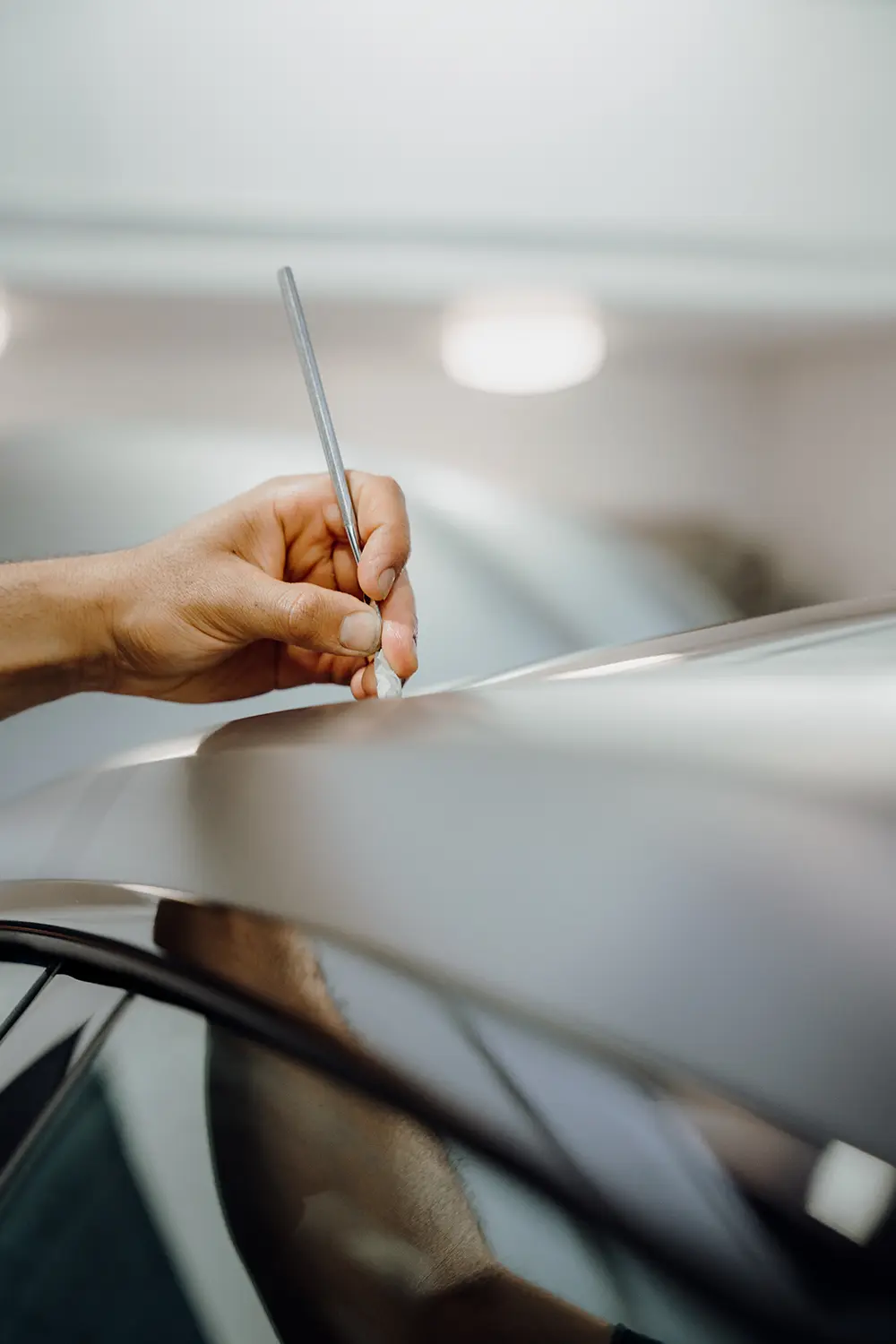
Shaped rods go in behind the dent. Where there’s no access, glue tabs pull from the outside.
We read the dent
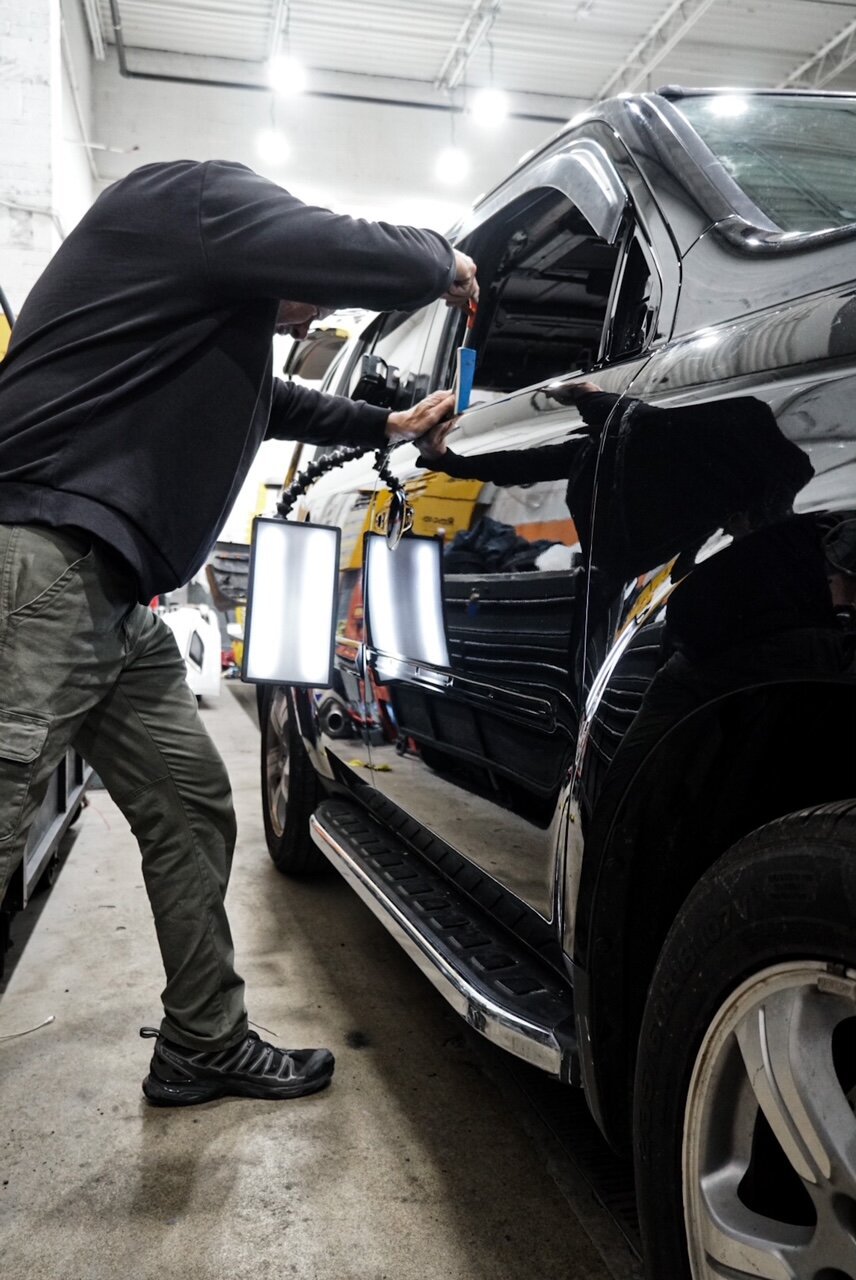
A striped light board shows every high and low spot on the surface.
We move the metal
Dozens of small, controlled pushes, not one big one. High spots get tapped back down.
We check the finish
The panel gets checked under light. No filler, primer or paint goes on it.
Aluminum panels are a different job
Range Rover, Defender, Discovery, Rivian R1T and R1S, and many Jaguars use aluminum outer panels. Aluminum is less forgiving than steel. It has a narrower window before it cracks, it often needs controlled heat, and it doesn’t relax the way steel does after a push.
We work with aluminum every day. On some of these dents, the right answer is still body work, and we’ll tell you that up front.
In the shop
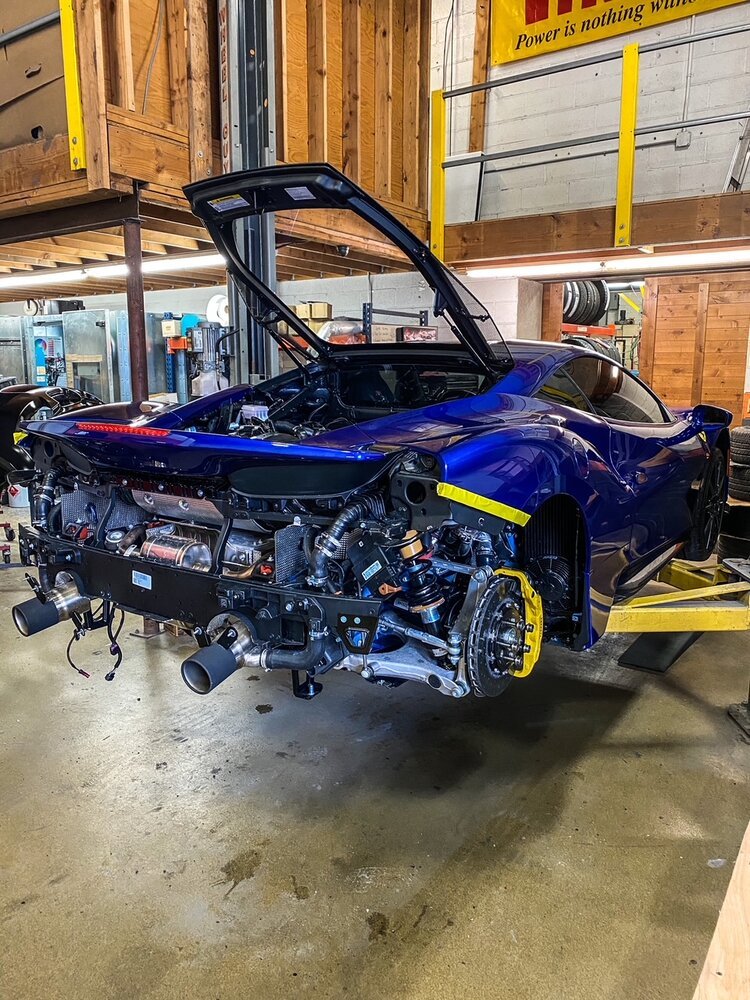
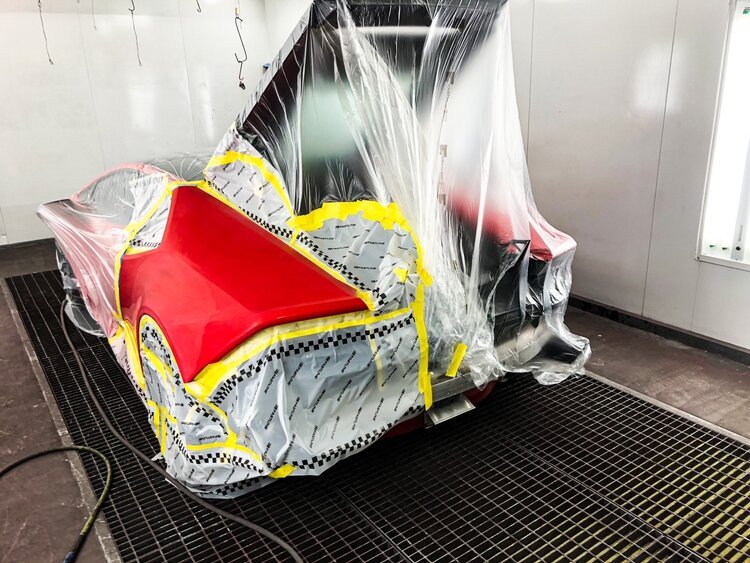
Photos from our shop. The first two show dent work. The second two show what a body work repair looks like.
Why bring a dent to a collision shop
A PDR-only shop can only sell you PDR. We can do either one, so you get the repair the dent actually needs.
- If it turns out to need body work, you don’t need a second shop.
- New OEM parts only, on any repair that needs a part.
- ADAS calibration in-house, if sensors are involved.
- We write the estimate and deal with your insurer directly.
- We primarily work on BMW and above, but we accept all cars.
- Pickup and delivery is available. It’s free locally, out to about Greenwich, CT. Farther out it may cost extra.
- Scratches but no dent? Paint correction may be what you need.
We’re a certified collision repair shop for Rivian, Jaguar Land Rover, Genesis, Infiniti, Nissan, Kia and Stellantis, and an XPEL Certified Installer. Those credentials cover collision repair and film. See our Jaguar Land Rover and Rivian pages.
Tell us about the dent
Let us know what happened and where the dent is. Add photos if you can. We’ll tell you whether it looks like PDR or body work.
Request an Estimate
Tell us about the car and what happened. We call back the same day. On a busy day, by the next morning at the latest.
Common questions
PDR pushes a dent back out from behind the panel with rods, or pulls it with glue tabs, without filler, sanding or paint. The factory finish stays in place.
Look at the paint first. If it’s chipped, cracked or scraped through, you need body work. If the paint is intact and the dent is shallow, PDR is usually an option. We’ll tell you which before we start.
Usually not. Accident damage tends to break paint, stretch metal or damage parts. That’s collision repair, and we do that here too. We’ll look at it and tell you straight.
Yes, if the paint is intact. Hail leaves many shallow dents on the hood, roof and trunk, which is the kind of damage PDR suits. Any panel with broken paint needs conventional repair.
A single door ding is usually same-day. Multiple panels or hail across the whole car take longer. We’ll give you a realistic time after we see the car.
Often, particularly for hail and comprehensive claims, but it depends on your policy. We write the estimate and deal with your carrier. Under New York Insurance Law section 2610, the choice of shop is yours.
PDR leaves the factory paint alone, so there’s no refinished panel for a paint gauge to find. That matters on a lease return or a car you plan to sell.
Yes, on the right dent. Aluminum is less forgiving than steel and often needs controlled heat. Range Rover, Defender, Rivian and many Jaguars have aluminum outer panels, and we work with aluminum every day.
Where we work
Our shop is in New Rochelle. Customers come to us from:
Enthusiast Auto Works
55B Plain Ave, New Rochelle, NY 10801
Open Monday to Friday
(914) 630-1668 · Contact us