
The first hour matters more than you think
Most of the expensive mistakes in a high-end collision repair happen in the first hour after the accident — before a single panel has been touched.
The car gets hooked to a flatbed by whoever the police called. It lands at a storage yard that charges by the day. Your insurer’s app assigns a “preferred” shop before you’ve had a chance to think. By the time you’re paying attention, your Range Rover is sitting in a queue at a volume shop that has never bonded an aluminum body panel, and the estimate has already been written to a number that assumes they won’t need to.
None of that is inevitable. Here is how the process actually works, what your rights are in New York, and what separates a repair that holds its value from one that quietly costs you thirty thousand dollars at resale.
Step 1: Control the tow
The single most useful thing you can do at the scene is decide where the car goes.
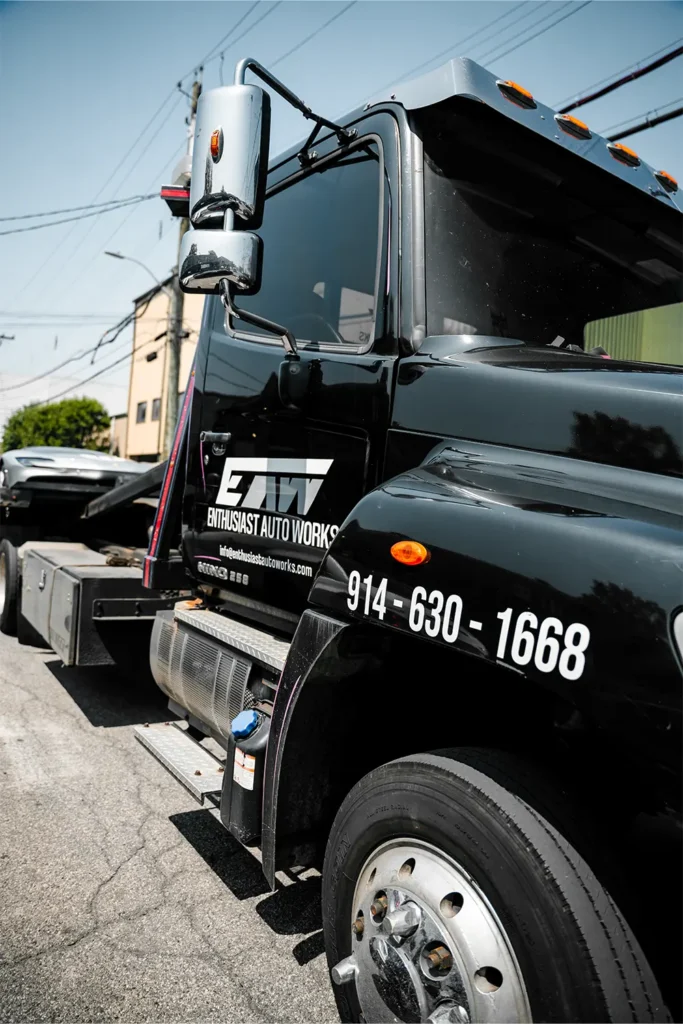
If the vehicle is drivable and you’re uninjured, you can often drive it straight to a shop of your choosing. If it isn’t, you are still allowed to tell the tow operator the destination. You are not obligated to let the car go to a police-contracted storage yard and sit there accruing fees, and you are not obligated to let it go to whichever shop the tow company has a relationship with.
What to say: “I want the vehicle taken to Enthusiast Auto Works, 55B Plain Ave, New Rochelle, New York.” Then call the shop so they know it’s coming.
A few specifics for high-end cars:
- Low-clearance exotics need a flatbed with a long, low-angle approach ramp or wooden blocks. A standard rollback will scrape a McLaren’s splitter. Say so.
- All-wheel-drive vehicles should never be towed with two wheels down.
- EVs with damage near the battery pack (Rivian R1T, R1S, Taycan, Lucid Air, Tesla) may require specific handling and, in some cases, quarantine distance from structures until the pack has been assessed. A shop that handles EVs regularly will tell the tow operator what it needs.
We handle pickup ourselves across Westchester, the Bronx, Manhattan, lower Fairfield County and Bergen County — see our pickup and towing service.
Step 2: Know your rights before you call the insurer
This is where most owners give away control without realizing it.
New York Insurance Law § 2610(a):
“Whenever a motor vehicle collision or comprehensive loss shall have been suffered by an insured, no insurer providing collision or comprehensive coverage therefor shall require that repairs be made to such vehicle in a particular place or shop or by a particular concern.”
§ 2610(b) goes further:
“In processing any such claim (other than a claim solely involving window glass), the insurer shall not, unless expressly requested by the insured, recommend or suggest repairs be made to such vehicle in a particular place or shop or by a particular concern.”
Read subsection (b) again. In New York, your insurer is not even supposed to suggest a shop unless you ask them to. The “preferred network” pitch — faster service, guaranteed work, we’ll handle everything — is a business arrangement between the insurer and that shop, built around negotiated labor rates and parts sourcing. It exists to manage the insurer’s severity costs. It is not a quality ranking, and it carries no obligation for you.
Connecticut and New Jersey have comparable protections. You choose the shop. The insurer owes what the repair costs. The full explanation of your rights is here.
What this means practically: when the adjuster asks where you’d like the car, name your shop. When they tell you a shop is “not in network,” the correct response is that you are exercising your right to choose, and that the shop will handle the supplement process directly with them. A good shop does this every day and will not ask you to referee.
Step 3: Understand what “certified” actually means — and what it doesn’t
This is the part of the industry with the most noise in it, so let’s be precise.
An OEM certification is a formal program. The manufacturer audits the facility, requires specific brand tooling (often six figures of it), mandates factory training for named technicians, requires the shop to buy into the brand’s repair-procedure database, and re-audits on a schedule. A shop either holds a given brand’s certification or it does not. There is no partial credit, and every manufacturer publishes a locator you can check yourself.
A technician certification is different and also real — I-CAR, welding credentials, aluminum-structural credentials, high-voltage safety training. These travel with the technician and apply across brands.
“We work on that brand” is not a certification at all. Many excellent shops repair cars they aren’t certified for, and that’s entirely legitimate — it just isn’t the same claim.
Be skeptical of any shop whose website claims certification for eight or ten luxury brands at once. Very few facilities in the country hold that many, because the tooling and floor-space requirements conflict with each other.
Where Enthusiast Auto Works stands
We’ll be direct about ours, because you can verify all of it:
- Jaguar and Land Rover Certified Collision Center — the full JLR program, including the aluminum-structural requirements. Details here.
- Rivian Certified Collision Network — factory-trained on R1T and R1S structures and high-voltage safety. Details here.
- Additional OEM certifications including Genesis, Infiniti, Kia, Nissan and the Stellantis brands.
- XPEL Certified Installer for paint protection film, ceramic coating and window tint.
We also repair Porsche, Ferrari, Lamborghini, McLaren, Bentley, Rolls-Royce, Aston Martin, Mercedes-AMG, BMW M, Tesla and Lucid — regularly, with technicians who hold aluminum, structural welding and high-voltage credentials, working to each manufacturer’s published repair procedures. We are not a factory-certified center for those brands, and we don’t claim to be. If a repair on your car genuinely requires a brand-certified facility, we’ll tell you that rather than take the job.
That distinction costs us some business. It’s also the reason dealers and collectors send us cars.

Step 4: The four things that actually make a luxury repair hard
Aluminum and mixed-material structures
A Range Rover, an F-Type, an R1T, a Panamera, most modern German sedans — these are not steel monocoques. They are aluminum, sometimes with magnesium castings, high-strength boron steel, carbon fiber, and structural adhesive holding it together.
Aluminum cannot be heated and pulled like steel. It work-hardens, it fatigues, and it does not signal distress the way steel does before it fails. Joining is done with self-piercing rivets, flow-drill screws and structural adhesive to a specified cure schedule — not with a MIG welder.
It also can’t share air with steel. Aluminum dust in contact with steel causes galvanic corrosion, which is why the certification programs require a physically separated, dedicated aluminum repair area with its own tooling, its own extraction and its own consumables. A shop that grinds aluminum in the same bay it grinds steel is creating corrosion you will not see for three years.
ADAS — the electronics you can’t see
Adaptive cruise, lane keeping, blind-spot monitoring, automatic emergency braking, surround-view. These run off radar units, cameras and ultrasonic sensors mounted in bumpers, grilles, windshields and mirrors — exactly the parts that get replaced in a collision.
Remove and refit a front bumper and the forward radar’s aim can shift by a fraction of a degree. At highway distance, that fraction is several feet of error. The system will not throw a warning light. It will simply be wrong.
Post-repair ADAS calibration — static, dynamic, or both, depending on the manufacturer — is a mandatory operation, not an upsell. It requires targets, a level floor, controlled lighting and measured distances. Ask any shop whether they calibrate in-house or sublet it, and ask to see the calibration report in your final documentation. If a shop doesn’t produce one, that’s your answer.
High-voltage systems
On an EV or hybrid, the pack is structural as well as electrical. Any impact near it requires a documented inspection: physical damage, thermal events, isolation faults, coolant loop integrity. Technicians need current high-voltage safety training and the right insulated tooling to de-energize and re-energize the system.
There are also manufacturer-specific rules about what a damaged pack means for the repair. Some require replacement rather than repair above a damage threshold — which can turn a cosmetically moderate accident into a total loss, and you want to know that early.
Paint on a car people look at closely
Tri-coat whites, candy reds, liquid-metal silvers, matte and satin finishes, and anything from a manufacturer’s bespoke program. These are not mix-and-spray colors. They require spray-out cards, variant matching under multiple light sources, and often blending into adjacent panels rather than a hard edge at the seam.
Matte and satin paint is its own discipline. It cannot be polished. A shop that buffs a matte panel has ruined it, and the fix is a full refinish.
Step 5: The estimate, the supplement, and what “total loss” really means
The first estimate is almost never the final number, and that’s normal rather than sinister.
An initial estimate is written from visible damage. Once the car is disassembled — a teardown, which a good shop does early — the hidden damage appears: a bent rad support, a cracked bracket, a pushed rail, a sensor that won’t calibrate. The shop then writes a supplement to the insurer. On a high-end car it’s routine for the supplement to exceed the original estimate.
A few things worth knowing:
- OEM vs. aftermarket parts. Some policies allow the insurer to specify aftermarket or recycled parts. On a certified repair, brand programs generally require new OEM parts for structural and safety components. Check your policy for an OEM parts endorsement — on a six-figure car it is cheap and worth having.
- Diminished value. Even a perfect repair leaves a car with an accident on its history report, and that costs real money at sale. In New York you can generally pursue a diminished-value claim against the at-fault party’s insurer in a not-at-fault accident. It’s a separate claim from the repair.
- Total loss. An insurer declares a total when repair cost plus salvage approaches actual cash value. On EVs, a damaged battery pack can trigger this much earlier than the body damage suggests. If you disagree with the valuation, you can supply comparable listings and, in most policies, invoke appraisal.
We handle the estimate, teardown, supplement and insurer negotiation in-house. Start a claim with us here.
Step 6: The part almost every shop skips — finishing the car properly
Here’s the thing that changes the math on a luxury repair, and it’s the reason we built the shop the way we did.
When your car leaves a conventional body shop, you have one or two panels of brand-new paint next to eight panels of paint that have spent four years on the Hutch. Even a flawless color match looks different, because the old paint has oxidized, has swirl marks from car washes, and has lost gloss. The new panel is too good. People notice the repair for exactly the opposite of the reason they expect.
The finish work is what closes that gap:
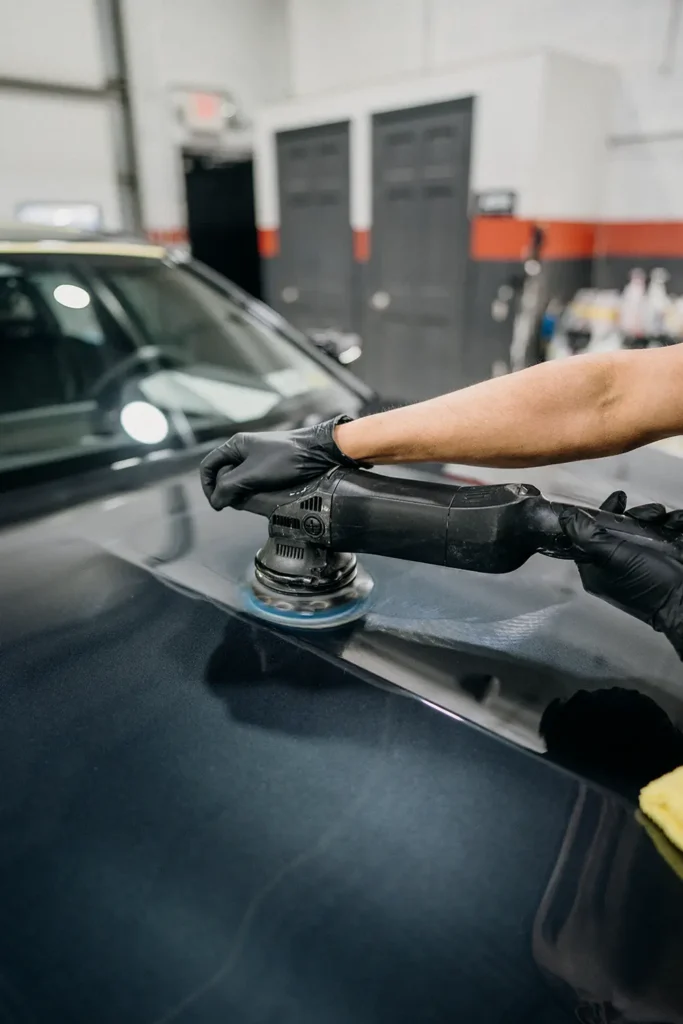
- Paint correction on the untouched panels so the whole car reads at the same gloss level. More on paint correction.
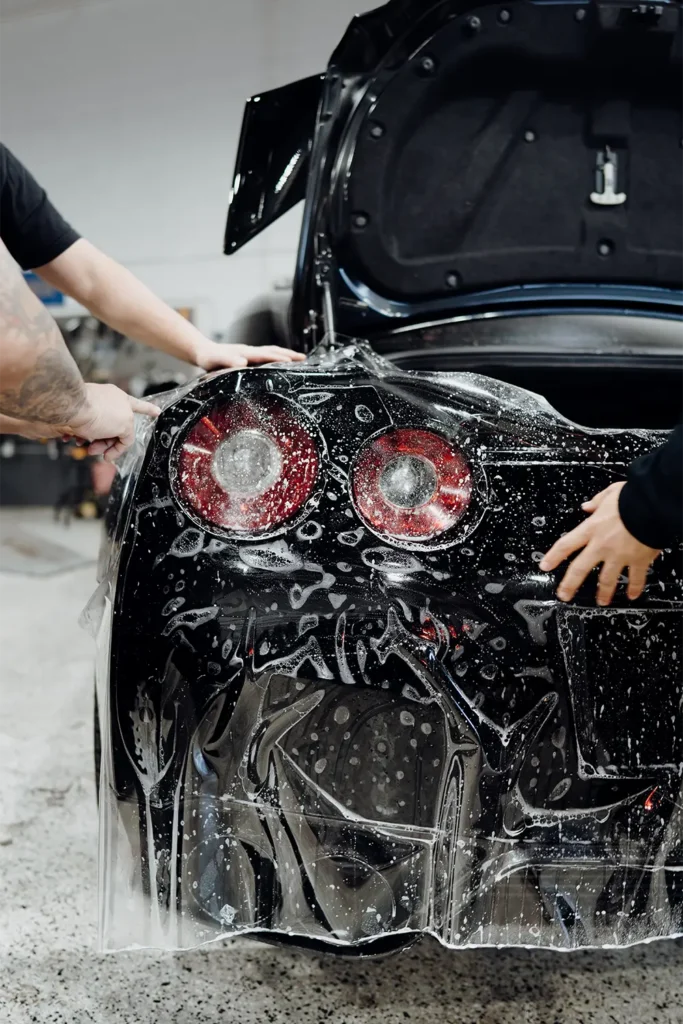
- Paint protection film over the corrected and refinished surfaces, so the repair you just paid for is the last time you deal with rock chips on that hood. XPEL PPF details.
- Ceramic coating on top for chemical resistance and easier washing.
- Wheel refinishing and caliper work if the accident scuffed a wheel — because one refinished wheel among three worn ones is as obvious as one new panel.
Most owners do this in three trips to three businesses over two months, paying to move the car each time and re-explaining what they want. There is no reason for that. The car is already apart, already in a clean paint environment, already in our hands.
One important timing note: fresh paint needs to outgas before film goes on it. Solvents continue leaving the clear coat for a period after the car comes out of the booth, and sealing that under PPF too early can cause adhesion problems or visible blistering. The correct sequence is refinish → cure → correct → film. A shop that does both under one roof manages that schedule for you instead of sending you to an installer who has no idea when the car was painted.
That’s what “one-stop shop” means here. Not a marketing line — a sequence that only works when one facility controls it end to end.
Frequently asked questions
No. Under New York Insurance Law § 2610(a), an insurer cannot require that repairs be made at a particular shop. Subsection (b) additionally bars the insurer from recommending or suggesting a specific shop unless you ask. You choose the facility; the insurer pays the cost of the repair.
Light cosmetic work typically runs one to two weeks. Structural repair involving aluminum, rivet-bonding and ADAS recalibration commonly runs three to six weeks. The largest variable is parts — low-volume and exotic components are often built to order in Europe, and a single backordered bracket can add weeks. You should get a real timeline after teardown, not before.
Usually yes, and the reason is resale rather than warranty. A documented repair performed to manufacturer procedure with OEM parts, with a calibration report attached, holds substantially more value at sale than an undocumented one — especially on brands where buyers pull service history.
If you claim through your own collision coverage, generally yes up front, with the deductible recovered through subrogation once your insurer collects from the at-fault carrier. If you claim directly against the at-fault party’s liability coverage, there is typically no deductible — but that route can be slower where fault is disputed.
Yes, in most cases, and we do it constantly — Porsche, Ferrari, Lamborghini, McLaren, Bentley, Tesla and others. Our technicians hold aluminum, structural and high-voltage credentials and we work to each manufacturer’s published procedures with OEM parts. What we won’t do is describe ourselves as certified by a brand that hasn’t certified us, and if a specific repair genuinely requires a brand-certified facility, we’ll tell you.
After, and with a cure interval. Fresh paint continues to release solvent for a period after refinishing, and film applied too early can develop adhesion or blistering problems. The correct order is refinish, cure, paint correction, then film.
Bring the car to one place
Enthusiast Auto Works is a Jaguar Land Rover and Rivian Certified Collision Center and an XPEL Certified Installer in New Rochelle, New York — one facility that handles the tow, the claim, the structural repair, the calibration, the paint, the correction and the protection film.
We pick up and deliver across Westchester, the Bronx, Manhattan, lower Fairfield County and Bergen County at no charge.
55B Plain Ave, New Rochelle, NY 10801 — (914) 630-1668
Start a claim · See our work · Collision repair
Request an Estimate
Tell us about the car and what happened. We will call you back, usually the same business day.