
Who this is for
You’ve got a car you actually care about, you’ve noticed the leading edge of the hood is starting to look like it lost an argument with the Merritt Parkway, and someone told you to look into paint protection film. Now you’re reading marketing copy from forty different shops that all say “premium,” “flawless” and “invisible.”
This is the version without that. What the film is, what it costs, which one to get, what a good installation looks like, and how to tell whether the shop quoting you knows what they’re doing.
We’re an XPEL Certified Installer in New Rochelle, New York, and we’ll say up front that we sell this — but the guide below is the same advice we give people who end up going somewhere closer to home.
What paint protection film actually is
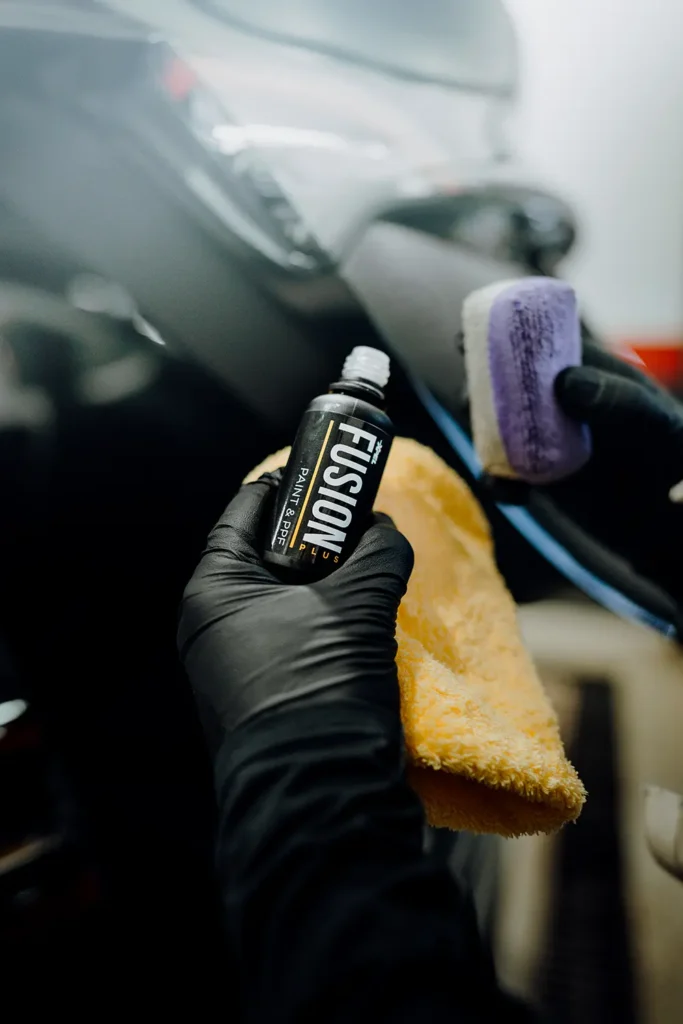
PPF is a clear thermoplastic polyurethane film — roughly 8 mils thick on premium products — with an adhesive layer underneath and an elastomeric topcoat on top. It goes over your factory paint.
It does two jobs:
Impact absorption. A stone off a truck tire at 65 mph hits the film instead of the clear coat. The urethane deforms, absorbs the energy and springs back. This is the actual point of the product, and it is why film goes on hoods, bumpers, fenders, mirrors, A-pillars and rocker panels first — the surfaces that eat road debris.
Self-healing. The topcoat on modern premium films is engineered so that light scratches and swirl marks — the kind that come from a bad car wash or a dusty microfiber — close up when heated. Sun on a warm day usually does it. A heat gun or hot water does it on demand.
What it does not do: stop a shopping cart, stop a door ding, stop a keying that goes through to metal, or make your car impervious. It is armor against the small, constant, cumulative damage that turns a three-year-old front end into a resale problem.
Ultimate Plus vs. Stealth vs. Ultimate Fusion — which one
XPEL’s lineup causes more confusion than it should, so here it is plainly.
XPEL Ultimate Plus
The default choice and the right answer for most cars. High-gloss, optically clear, self-healing topcoat, strong stain resistance, and XPEL’s 10-year manufacturer warranty against yellowing, cracking, bubbling and delamination.
On a gloss-painted car, applied correctly, you should not be able to see it from three feet away.
Get this if: your car has conventional gloss paint and you want maximum protection with no change in appearance.
XPEL Stealth
Same film, matte finish. It converts a gloss-painted car to a satin look — and protects it at the same time.
It’s also the only correct answer if your car already has factory matte or satin paint. Matte paint cannot be polished or waxed, which means it has no recovery path from scratches. Stealth film over factory matte is genuinely protective rather than cosmetic, because it gives that finish a sacrificial layer it otherwise doesn’t have.
Get this if: you want a satin finish, or you own a factory matte car (AMG magno, BMW Frozen, Porsche Paint to Sample matte, Rivian satin). We do full Stealth conversions.
XPEL Ultimate Fusion
Ultimate Plus with a ceramic-infused topcoat — more hydrophobic out of the box, so water beads and sheets off the film without a separate coating step.
Get this if: you want the coating benefits built in and prefer fewer layers. Note that you can also just apply a ceramic coating over Ultimate Plus, which is what most shops including ours typically do, because it lets the coating be refreshed independently of the film.
And the windshield
XPEL windshield protection film is worth a separate mention, because modern windshields on ADAS-equipped cars are genuinely expensive to replace, and on most of them the forward-facing camera has to be recalibrated afterwards, which is a second bill on top of the glass. A film that prevents one chip can pay for itself the first time it does.
What drives the cost
Every PPF quote is built from the actual car, which is why no shop publishes a menu that means anything. Two cars of the same value can differ by a factor of two in labor. Here is what a good installer is actually pricing when they look at your vehicle.
- Panel complexity. A Range Rover has large, relatively flat panels and wraps quickly. A McLaren 720S has compound curves, air intakes and negative-radius edges everywhere, and takes more than twice the labor for less coverage area.
- Coverage. A partial front (partial hood and fenders, bumper, mirrors) is a fraction of the work of a full front, and a full front is a fraction of a full-vehicle wrap. Rockers, A-pillars, roof edge, door cups and rear wheel arches each add real time.
- Wrapped vs. cut edges. More on this below — it is the single biggest cost and quality variable, because wrapping edges means disassembling the car.
- Disassembly. A proper install removes badges, mirror caps, headlights, grilles and trim so film can tuck behind rather than die at a visible edge. Shops that don’t disassemble are faster and cheaper, and it shows.
- Paint condition. Film goes over whatever is underneath it. If the paint has swirls, etching or orange peel, that gets sealed in and magnified. Most premium installs include a paint correction step first, and a car that needs real correction adds labor before a single panel of film goes on.
- Film choice. Ultimate Plus, Stealth and Ultimate Fusion are not priced the same, and windshield film is quoted separately because it may require ADAS recalibration.
The practical consequence: if one quote is dramatically below the others, it is almost never the same job. It usually means the film is being cut on the car rather than plotted and wrapped, and nothing is coming apart. That is a real service — it just isn’t the one the higher quotes describe.
We quote from photos or from the car in front of us, in writing, with the coverage spelled out panel by panel so you can compare it against anyone else’s. Send us the year, make, model and a few photos of the front end and we’ll come back with a number for your car.
How to tell a good installation from a bad one
This is the part worth memorizing, because the film is a commodity and the install is not. Same product, two shops, wildly different outcomes.
1. Wrapped edges, not cut edges. A cut edge is a visible line where the film stops mid-panel. It collects dirt, it lifts eventually, and you can see it from across the parking lot. A wrapped edge tucks the film around the panel edge and behind the adjacent part. It requires disassembly and it’s invisible. Ask directly: “Are you wrapping the edges or cutting them on the panel?”
2. No cutting on the car. Ever. There are installers who lay film on a panel and trim it with a blade against your paint. There is no version of this that is acceptable on a car you care about. Every cut is a potential score line in your clear coat. Modern shops use computer-plotted patterns cut on a table, with hand-trimming done off the vehicle.
3. A clean, controlled environment. Film is applied wet, and every airborne particle that lands during the tack window becomes a permanent bump under the film. The bay should be enclosed, filtered, lit hard, and not the same room where someone is sanding a fender.
4. Real cure time. The film needs to sit — usually 24 to 48 hours, longer in cold weather — before the car goes out in the rain or through a wash. Any moisture haze under the film should clear during this window.
5. The pre-inspection. A good shop photographs the car before touching it, points out existing rock chips and scratches, and tells you what will be visible under film and what correction would cost to fix first.
PPF vs. ceramic coating — you probably want both
These get pitched as alternatives. They’re not; they solve different problems.
| Paint protection film | Ceramic coating | |
|---|---|---|
| Rock chips | Yes — this is its job | No |
| Scratches | Yes, and self-heals light ones | Light marring only |
| Chemical etching (bird, sap, road salt) | Good | Excellent |
| Water beading / easy washing | Moderate | Excellent |
| Gloss enhancement | Slight | Noticeable |
| Thickness | ~8 mil | ~2–3 micron |
| Lifespan | 10 years (Ultimate Plus warranty) | 2–5 years |
The standard high-end build is film on the impact surfaces and ceramic coating over the entire car including the film. The film stops the stones, the coating makes the whole car easier to keep clean and more resistant to the salt that Westchester and Fairfield County roads are buried in from December to March.
If the budget only covers one: on a new car, film the front end. Chips are permanent and coating won’t prevent a single one.

The road-salt problem nobody mentions
Anyone driving I-95, the Hutch, the Merritt or the Saw Mill between December and March is driving through brine. Not rock salt — liquid magnesium chloride, sprayed before storms, which stays wet, creeps into seams, and is considerably more aggressive toward paint and aluminum than the rock salt everyone pictures.
This matters for two reasons:
Rockers and lower doors. These take the most brine and are almost always skipped on “full front” packages. On a car you plan to keep, rocker panel and lower-door film is the least glamorous and highest-value coverage you can buy.
Aluminum-bodied cars. Range Rover, Defender, Rivian R1T and R1S, Jaguar F-Pace, and most modern luxury SUVs have aluminum outer panels. Aluminum doesn’t rust the way steel does, but it does corrode — and it starts at any point where the paint is breached. A rock chip on an aluminum hood in a brine climate is a corrosion site, not just a cosmetic one. Film over that hood is doing structural work.
The one thing to get right if you’re also repairing the car
If your car is going through body work, here’s a sequence that saves a lot of grief: refinish → cure → correct → film, in that order, with a real interval between paint and film.
Fresh paint keeps releasing solvent after it leaves the booth. Sealing a newly refinished panel under PPF too early can trap that outgassing and produce adhesion failure or visible blistering weeks later. There’s no fix short of pulling the film and often redoing the panel.
This is a genuine advantage of doing both under one roof: the shop knows exactly when the panel was sprayed and schedules the film accordingly. We’re a certified collision repair center as well as an XPEL installer, which means the repair, the cure schedule, the correction and the film all happen on one timeline in one building.
Where we are and how far we come
We’re at 55B Plain Ave, New Rochelle, NY 10801 — one of a small handful of XPEL installers in Westchester County.
We offer free pickup and delivery across roughly a 40-mile radius, which covers:
Westchester: New Rochelle, Larchmont, Mamaroneck, Rye, Harrison, Scarsdale, Bronxville, Eastchester, Tuckahoe, Pelham, White Plains, Mount Vernon, Yonkers, Port Chester, Purchase, Armonk, Chappaqua, Bedford, Katonah
NYC: Manhattan, the Bronx, Riverdale, Queens
Fairfield County, CT: Greenwich, Cos Cob, Riverside, Old Greenwich, Stamford, Darien, New Canaan, Norwalk, Westport
Bergen County, NJ: Alpine, Tenafly, Cresskill, Demarest, Englewood, Englewood Cliffs, Fort Lee, Saddle River, Closter
Rockland: Nyack, Pearl River, Montebello
If you’re in that radius, you don’t have to drive the car to us, and you don’t have to be without it longer than the work takes.
Frequently asked questions
Coverage and labor, not the film itself. The main variables are how much of the car is covered, how complex its panels are, whether the installer wraps the edges (which requires disassembling badges, mirrors, headlights and trim) or simply cuts the film on the panel, whether the paint needs correction first, and which XPEL film you choose. A car with compound curves and deep intakes can take more than twice the labor of a large, flat-panelled SUV for less coverage area. Any shop quoting without seeing the car or photos of it is quoting a category, not your vehicle.
XPEL warrants Ultimate Plus for 10 years against yellowing, cracking, bubbling and delamination. Real-world life depends on exposure — a garaged car will outlast a daily driver parked on the street.
Older-generation films did. Current premium films including XPEL Ultimate Plus have UV-stable topcoats and are warrantied against yellowing for the full 10-year term. Cheap unbranded film still yellows, often within two or three years.
Yes, when it is quality film applied to healthy factory paint and removed with heat by someone who has done it before. Removal from repainted panels, or from paint with existing adhesion problems, carries more risk — which is one reason a shop should inspect and document your paint before applying anything.
They do different jobs. Film stops rock chips and physical damage; coating provides chemical resistance and easier cleaning. The standard approach on a high-end car is film on the impact surfaces with ceramic coating over the whole vehicle. If you can only do one and the car is new, film the front end — chips are permanent.
It is the ideal time, because the paint is in its best condition and nothing needs correcting first. The only thing worth waiting for is any dealer-applied product that needs to come off first, and the manufacturer’s recommended interval if the car was repainted for transport damage.
Yes — XPEL Stealth is the correct product for that, and it is arguably more important on matte than on gloss, because matte paint cannot be polished and has no other route to recover from scratches.
Get a real quote
Send us the year, make, model and color, plus a few photos of the front end, and we’ll come back with a written quote for your car — coverage spelled out panel by panel, so you can compare it against anything else you’ve been quoted.
Enthusiast Auto Works — XPEL Certified Installer
55B Plain Ave, New Rochelle, NY 10801 · (914) 630-1668
Request a PPF quote · XPEL PPF service · The complete accident repair guide
XPEL now makes the same film in sixteen colors. If you are considering a color change, color-change PPF replaces vinyl wrap on high-end cars — thicker, self-healing, warrantied for ten years, and genuinely protective.
Request an Estimate
Tell us about the car and what happened. We will call you back, usually the same business day.