
The problem with finding a shop for a car like this
There are perhaps a dozen facilities between the Hudson and the Connecticut line that should be allowed near a 720S, and there are several hundred that will happily take the job.
The gap between them isn’t the estimate. It’s whether the shop understands that the car in their bay is built out of materials and processes that most of the collision industry never touches — and whether they know where the edge of their own competence is.
This is a guide to figuring out which kind of shop you’re talking to.
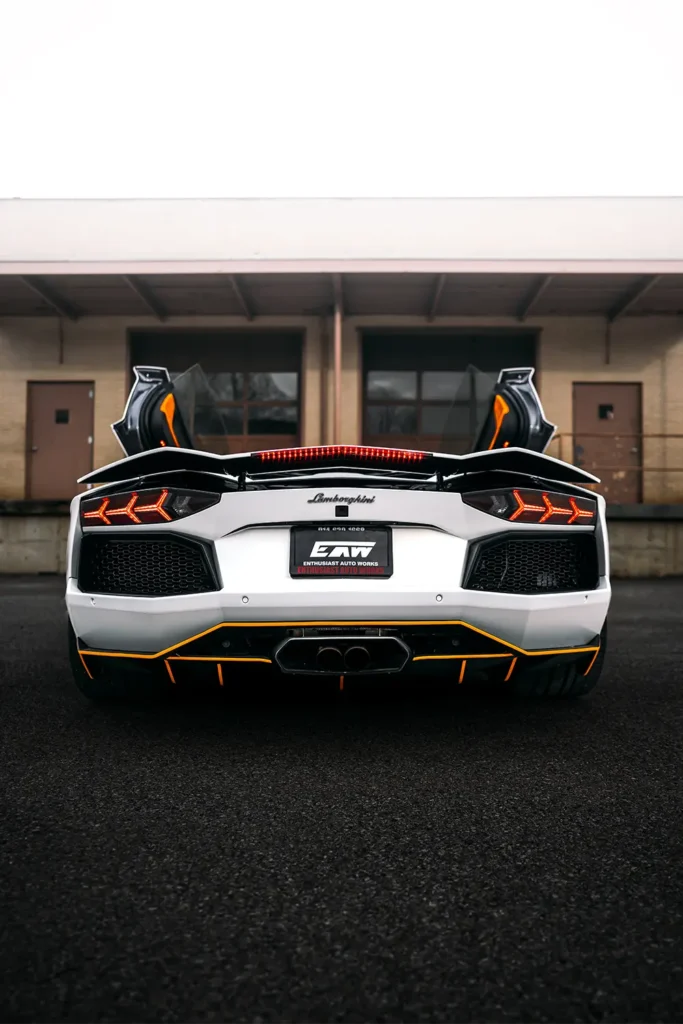
The five things that make an exotic repair different
1. Carbon fiber is not a body panel
On a McLaren, a modern Ferrari, an Aston, a Lamborghini Aventador or a Huracán, carbon fiber shows up in two completely different roles, and conflating them is the most expensive mistake in this business.
Cosmetic carbon — splitters, diffusers, mirror caps, engine bay trim, interior pieces — is largely a finish problem. Damage is repaired by removing the damaged clear, rebuilding the weave layer, and re-clearing. It’s skilled work and the weave alignment has to match, but it’s within reach of a good shop.
Structural carbon — a McLaren MonoCell or MonoCage, an Aventador monocoque, a chassis tub — is a different universe. These are engineered laminates with specific ply orientations and cure schedules, and their damage tolerance is not something you can evaluate by looking at it. Carbon fails differently from metal: it can delaminate internally with no visible surface damage at all, and that delamination is invisible without ultrasonic or thermographic inspection.
The honest position, which is also the manufacturers’ position: structural carbon tubs are generally not field-repairable. Most manufacturers specify replacement, and several restrict any assessment to designated facilities. A shop that tells you it can “repair the tub” on a MonoCage should be treated with deep suspicion.
What a competent shop does is inspect, identify what’s cosmetic and what’s structural, and tell you plainly which category you’re in — including when the answer means the car goes to a manufacturer-designated facility instead of theirs.
2. Aluminum and mixed-material construction
Almost every car in this category has an aluminum spaceframe or aluminum body panels, often mixed with high-strength steel, magnesium castings and composite.
The constraints are the same as on any aluminum vehicle and they’re unforgiving: no heat-and-pull repair (aluminum work-hardens and won’t tell you it has), narrow heat tolerances, joining by self-piercing rivet and structural adhesive rather than welding, and an absolute requirement that aluminum work be physically separated from steel work — because aluminum dust in contact with steel causes galvanic corrosion that surfaces two or three years after the repair.
Our aluminum capability is built to the standard required by our JLR certification — a physically isolated aluminum repair area with dedicated tooling, extraction and consumables — and that infrastructure serves every aluminum car that comes through, regardless of badge.
3. Paint that doesn’t come from a chart
Rosso Corsa, Grigio Silverstone, Arancio Borealis, Papaya Spark, and every Paint to Sample, Tailor Made, Ad Personam or MSO color underneath them. Tri-coats, candy reds with tinted clear, liquid metals, chromaflair, matte and satin.
These are not colors you pull from a formula and spray. They require spray-out cards and variant matching under multiple light sources; blending into adjacent panels rather than a hard edge at the seam; correct layer structure (a tri-coat is a ground coat, a translucent mid-coat and clear — matching the final color means matching the mid-coat film build, not just the color); and restraint with matte, which cannot be polished, buffed or waxed. A technician who reaches for a polisher on a satin panel has committed the shop to a full refinish.
4. Aero, ride height and the geometry nobody checks
A front-end impact on a low car frequently damages things that don’t show on an estimate: splitter mounting points, undertray geometry, active aero actuators, and on cars with hydraulic or electronic lift systems, the lift hardware itself.
Ride height on these cars is a performance and clearance parameter, not a preference. Getting it back to spec after a suspension or subframe disturbance requires corner-weighting on a level surface, not eyeballing the gap.
5. Electronics and driver assistance
Even the most analog-feeling supercar now carries radar, cameras and ultrasonic sensors — and the front bumper is where most of them live. Post-repair ADAS calibration applies here exactly as it does on a Range Rover, and the same warning holds: a misaimed radar reports healthy and behaves wrong.
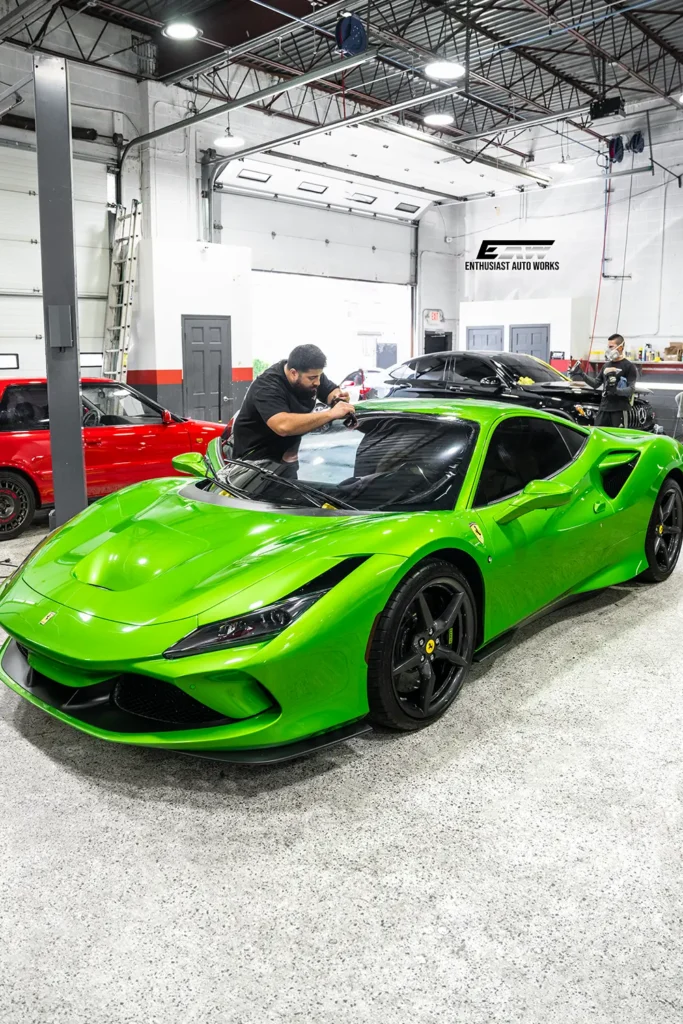
Where we stand — stated precisely
We think the certification question deserves a straight answer, because a lot of shops in this segment are deliberately vague about it.
We hold these OEM collision certifications:
- Jaguar Land Rover — full JLR Certified Collision Repair Center, including the aluminum structural program
- Rivian — Rivian Certified Collision Network
- Genesis, Infiniti, Kia, Nissan and the Stellantis brands
- XPEL Certified Installer for paint protection film, ceramic coating and window tint
We regularly repair, but are not factory-certified by: Ferrari, Lamborghini, McLaren, Porsche, Bentley, Rolls-Royce, Aston Martin, Maserati, Mercedes-Benz and AMG, BMW and M, Audi, Tesla and Lucid.
For those cars we work to each manufacturer’s published repair procedures with genuine parts, using technicians who hold aluminum, structural joining, welding and high-voltage credentials, on the same equipment and in the same dedicated aluminum facility that the JLR and Rivian programs require. That’s a real capability and it’s why dealers and collectors send us cars.
It is also not the same thing as being certified by Ferrari, and we’re not going to write that we are.
And if your car needs a brand-certified facility, we’ll say so. A structural carbon tub, a repair where the manufacturer restricts parts to its own network, a warranty situation that requires a designated shop — those are cases where the right answer is somewhere else, and you’ll get that answer from us before you’ve paid us anything.
You can verify the certifications we do claim on the manufacturers’ own locators. We’d rather you did.
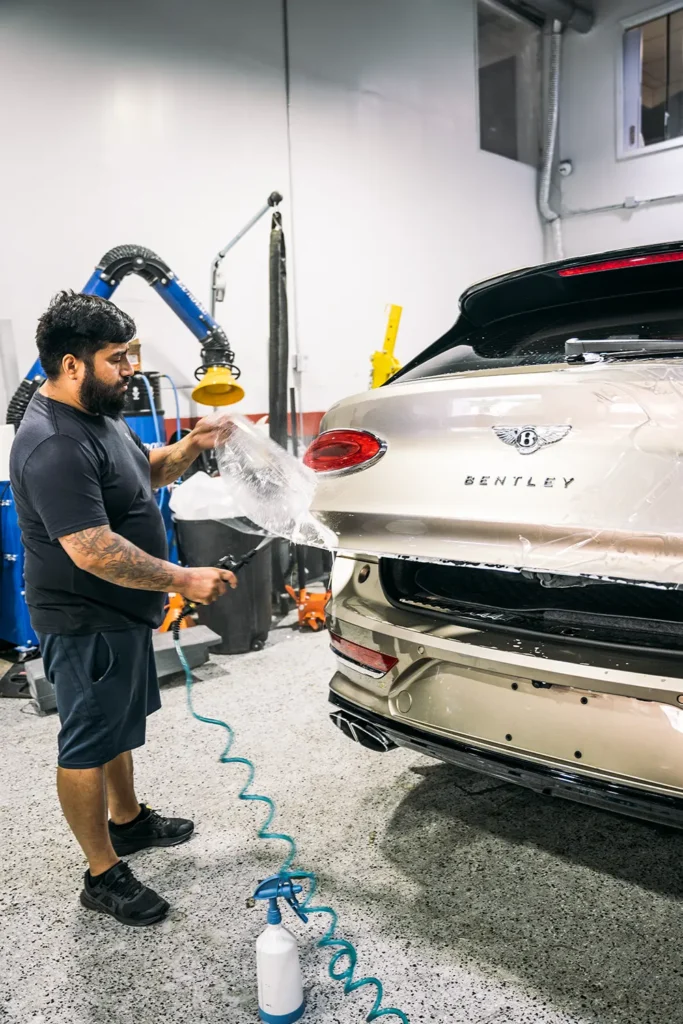
What to ask any shop before you hand over the keys
A short list that separates capability from marketing:
- “Are you certified by my car’s manufacturer, and can I check that on their locator?” A confident yes with a pointer to the manufacturer’s site is good. A confident yes with no verification path is worth a second look. An honest “no, but here’s what we do hold” is worth more than a vague yes.
- “Do you have a separate aluminum repair area?” Ask to see it. It should be a room, not a corner.
- “Will you pull the manufacturer’s repair procedure for this job?” The answer should be yes and matter-of-fact.
- “Do you calibrate ADAS in-house or sublet it, and will I get the calibration report?” You want the report either way.
- “How do you handle a tri-coat / my specific color?” If the word “spray-out” doesn’t come up, keep looking.
- “When will you tear it down?” Early teardown means parts get ordered early. On an exotic with European-sourced parts, this is often the whole ballgame on timeline.
- “What’s your plan for the panels you’re not painting?” A shop that hasn’t thought about gloss match across the whole car is going to hand you a repair you can see.
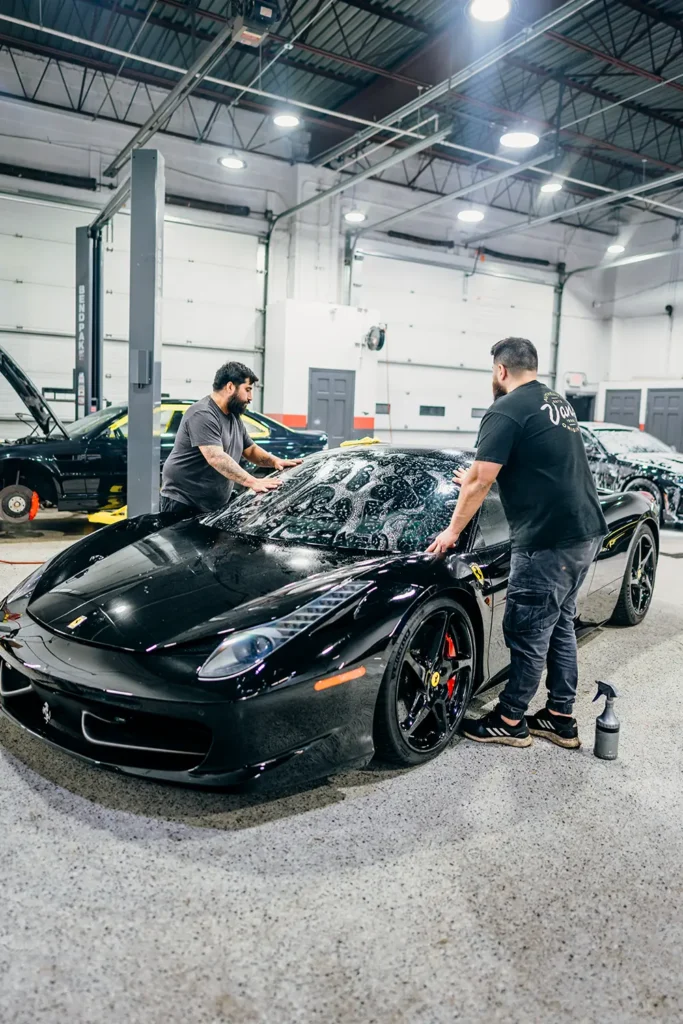
The finish: why the untouched panels decide how the repair looks
Here’s the failure mode that frustrates owners most, and it has nothing to do with the quality of the body work.
Your car comes back with a perfectly matched, perfectly laid refinished fender. Next to it are seven panels that have spent four years accumulating swirl marks, water spotting and oxidation. The new panel is better than the old ones, and that’s exactly why the repair is visible. The color matches. The condition doesn’t.
Closing that gap is three steps, and they belong at the end of the same work order rather than at three businesses over two months:
Paint correction across the untouched panels so the whole car reads at one gloss level.
Paint protection film over the refinished and corrected surfaces — because the hood you just paid to have painted is the one that eats stones on the Merritt. XPEL Ultimate Plus on gloss, Stealth if the car is matte or satin — and if it is, film is the only protection option you have, since matte can’t be polished.
Wheel and caliper refinishing if the accident scuffed a wheel. One refreshed wheel next to three curbed ones is as conspicuous as one new panel.
One sequencing rule that a lot of owners learn the hard way: fresh paint has to outgas before film goes over it. Solvent continues leaving the clear coat after the car comes out of the booth, and sealing that under PPF too early produces adhesion failure or blistering weeks later. Refinish → cure → correct → film, with a real interval.
Frequently asked questions
Cosmetic carbon — splitters, diffusers, mirror caps, trim — can usually be repaired by rebuilding the damaged laminate and re-clearing with the weave correctly aligned. Structural carbon, such as a McLaren MonoCell or an Aventador monocoque, is a different matter: manufacturers generally specify replacement rather than repair, and internal delamination can exist with no visible surface damage. Any shop offering to repair a structural carbon tub should be questioned closely.
You are free to choose any shop. Whether you should depends on the damage. Cosmetic and most non-structural work is well within reach of a capable independent facility with aluminum capability and the right paint discipline. Repairs involving structural composite, restricted parts, or an active warranty question are cases where a brand-designated facility is the right call — and a good independent shop will tell you when you are in one.
No. Under New York Insurance Law § 2610(a), an insurer cannot require repairs be made at a particular shop, and § 2610(b) bars it from even recommending one unless you ask. Connecticut and New Jersey have comparable protections. This matters more on an exotic than on anything else, because insurer preferred networks are built around labor rate agreements and rarely include facilities equipped for these cars.
Longer than you want, and parts are usually why. Bodywork and paint on a moderate repair might be three to five weeks of actual labor; the calendar time is driven by components built to order in Italy or the UK. Ten to sixteen weeks is common on anything structural. An early teardown, so every part is ordered in the first week, is the single biggest thing that shortens it.
An accident on the history report costs value regardless — that is diminished value, and in a not-at-fault New York accident you can generally pursue it against the at-fault party’s insurer as a separate claim. What you control is how much: a documented repair with OEM parts, correct procedures, a calibration report and proper paint work holds far more value than an undocumented one.
Yes, regularly. Our OEM collision certifications are with Jaguar Land Rover and Rivian, plus Genesis, Infiniti, Kia, Nissan and the Stellantis brands, and we are an XPEL Certified Installer. We are not factory-certified by Ferrari, Lamborghini, McLaren, Porsche or Bentley, and we don’t claim to be — we repair those cars to the manufacturers’ published procedures with genuine parts, using technicians who hold aluminum, structural and high-voltage credentials.
Bring it in, or we’ll come get it
Enthusiast Auto Works is a JLR and Rivian Certified Collision Repair Center and XPEL Certified Installer in New Rochelle, New York, with a dedicated aluminum facility, bespoke color matching, in-house ADAS calibration, and an enclosed environment for film and coating work.
Enclosed and low-clearance transport available. Free pickup and delivery across Westchester, the Bronx, Manhattan, lower Fairfield County and Bergen County.
55B Plain Ave, New Rochelle, NY 10801 — (914) 630-1668
Start a claim · See our work · The complete accident repair guide
Request an Estimate
Tell us about the car and what happened. We will call you back, usually the same business day.