
The short answer
Wait at least 30 days after a panel is refinished before applying paint protection film — and ask the shop what they sprayed, because the answer moves.
Some modern high-solids clears that are force-cured in a downdraft bake booth are ready considerably sooner, occasionally in as little as a week. Some air-dry or low-bake refinishes need 60 to 90 days. The film manufacturer’s guidance, the paint manufacturer’s technical data sheet, and the actual bake schedule the panel got all matter more than any rule of thumb.
If you take nothing else from this article: the shop that painted the car is the only party who knows the real answer, and most of the time nobody asks them.
Why fresh paint and film don’t get along
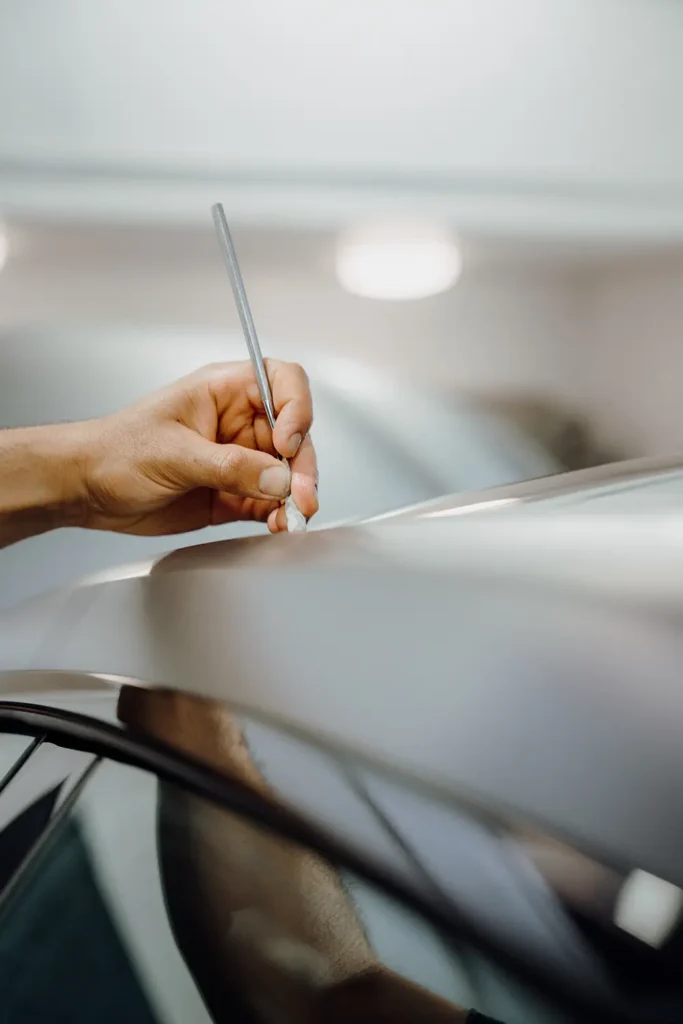
When a panel is refinished, the clear coat doesn’t finish curing the moment it stops being tacky. Solvents continue migrating out of the film for days to weeks afterward — a process called outgassing — and the coating continues cross-linking and hardening well past the point where it looks and feels finished.
Paint protection film is a sealed, adhesive-backed membrane. Putting it over a panel that’s still outgassing does two things:
It traps the solvent. The vapour has nowhere to go, so it collects at the adhesive interface. The visible result is bubbling, hazing or a milky cast under the film — sometimes appearing two or three weeks after an install that looked perfect on day one.
It attacks the bond. Solvent at the interface interferes with adhesion. The film lifts at edges, or releases in patches, or bonds inconsistently so that removal later tears the clear coat.
There’s also a quieter failure mode: film applied to under-cured, still-soft clear can imprint the panel — leaving a faint permanent edge line where the film’s border sat while the paint was still hardening. That one doesn’t show up until the film comes off, years later.
None of these are fixable in place. The film comes off, and depending on what happened underneath, the panel gets polished or gets refinished again.
What “30 days” actually depends on
| Factor | Effect on wait time |
|---|---|
| Force-cured in a bake booth (typically 140–160°F) | Shortest — much of the outgassing is driven off during the bake |
| Air-dried or low-bake refinish | Longest — commonly 60–90 days |
| High-solids / ceramic clear coats | Generally shorter, but check the TDS |
| Film build (how heavy the clear went on) | Heavier build, longer cure |
| Ambient temperature and humidity | Cold, damp shop conditions extend it substantially |
| Blended panels vs. full refinish | Blends over existing clear typically need less time |
This is why a blanket answer is unsatisfying. A hood force-cured at 60°C in a modern downdraft booth with a high-solids clear is a genuinely different situation from a bumper cover that was sprayed in an unheated bay in February.
The correct process is: the paint technician identifies the product used and the cure it received, checks the paint manufacturer’s technical data sheet for the film-application interval, and the film goes on after that. That’s a two-minute conversation between two people who work in the same building — and an unanswerable question when the body shop is in one town and the film shop is in another.
The right sequence, in order
For a car that’s been in an accident and is getting the full treatment, this is the order that works:
- Structural repair and refinish. Body work, panel replacement, priming, color, clear, bake.
- ADAS calibration and reassembly. Sensors back in, calibration performed and documented. This happens regardless of what comes after.
- Cure interval. The panel sits. This is the step everyone wants to skip. If the car is drivable, you can have it during this window — the cure happens whether the car is in the shop or in your garage.
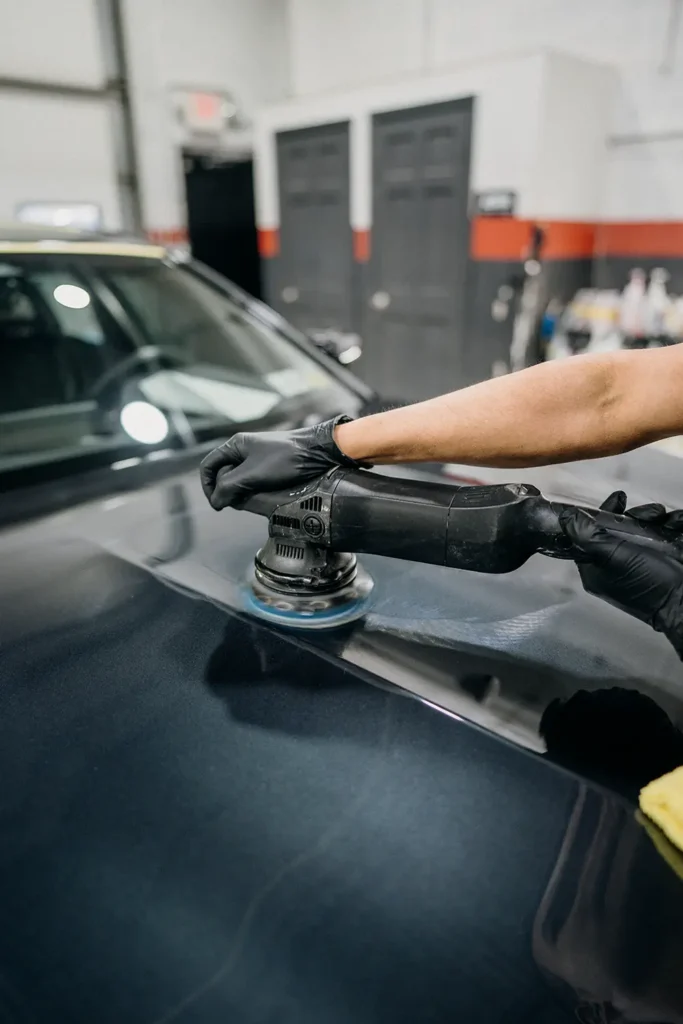
- Paint correction across the whole vehicle. Not just the repaired panels — the untouched ones. This is what makes the repair invisible. New paint next to four-year-old paint reads as a repair even with a perfect color match, because the old paint has oxidation and swirl marks and the new paint doesn’t. Note the ordering: correction comes after the cure, not before. Machine polishing generates heat and abrades the clear, and doing that to under-cured paint can burn through or mar it.
- Paint protection film. On the hood, fascia, fenders, mirrors, A-pillars, rockers — whatever the package covers. Clean, enclosed, filtered environment, edges wrapped rather than cut.
- Ceramic coating over the top. Over both the film and the unfilmed paint, so the whole car behaves the same in the wash.
- Film cure. 24 to 48 hours before the car sees rain or a wash, longer in cold weather.
Skip step 3 and you risk steps 5 and 6. Skip step 4 and the repair is visible forever regardless of how good steps 1 and 5 were.
Why splitting this across three businesses goes wrong
The conventional path for a luxury car after an accident looks like this: body shop does the repair, you pick the car up, a month later you drop it at a detailer for correction and coating, and somewhere in there a film installer gets it for three days.
Three drop-offs, three pickups, three intake conversations, and roughly two months of calendar time — most of which is scheduling rather than work.
But the scheduling isn’t the real cost. These are the actual failure points:
Nobody owns the cure interval. The film installer asks when the car was painted. You say “about three weeks ago, I think.” They apply. If it bubbles, the body shop says the film was applied too early and the film shop says the paint was defective, and you’re standing between two businesses who have never spoken to each other.
The correction happens in the wrong order, or twice. Detailers correct before filming because that’s their workflow. If the body shop already polished the fresh panels — which they shouldn’t have — that’s clear coat removed twice from paint that was still soft.
The gloss mismatch never gets addressed. The body shop’s job ended at the panel boundary. The detailer wasn’t told there was a repair. Nobody looks at the car as one object.
Warranty gets murky. Film lifts at an edge on a refinished panel: whose warranty? In practice, both parties point at the other, and the owner pays.
What one facility changes
When the repair, the correction and the film happen under one roof, on one work order:
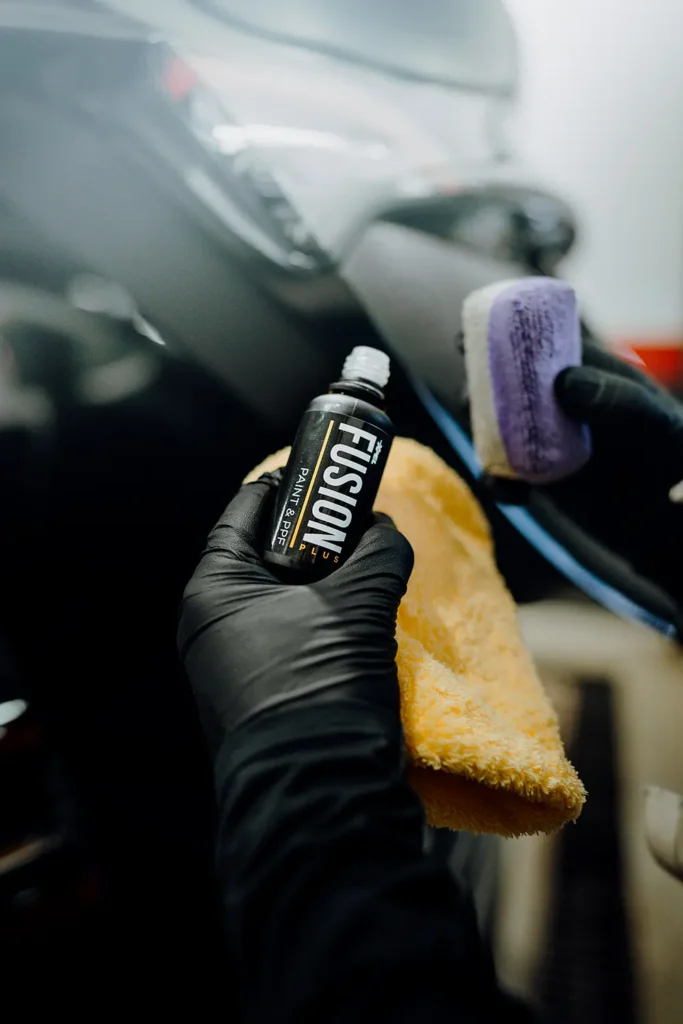
- The film technician can walk twenty feet and ask the paint technician what product went on the panel and what bake it got. The cure interval is a known number, not an estimate.
- The whole vehicle gets assessed as one object, so gloss levels get matched across repaired and unrepaired panels.
- The car is disassembled once. Badges, mirror caps, headlights and trim come off for the refinish, and the film gets wrapped behind those same edges before anything goes back on — which is how you get invisible edges without a second disassembly.
- One warranty, one point of accountability. If something lifts, there’s nobody to point at.
- One drop-off and one pickup instead of three.
This is the whole argument for a one-stop shop, and it’s a technical one rather than a convenience one. The convenience is real, but the reason it produces a better result is the cure interval and the single disassembly.
Frequently asked questions
Thirty days is a reasonable default, but the real answer depends on the clear coat product and how it was cured. Force-cured high-solids clears out of a bake booth can sometimes be filmed within one to two weeks; air-dried refinishes may need 60 to 90 days. Ask the shop that sprayed the panel what product they used and check the paint manufacturer’s technical data sheet — that is the number that governs.
Trapped solvent collects at the adhesive interface, producing bubbling, hazing or a milky appearance under the film — often two or three weeks after an install that looked perfect. It also interferes with adhesion, causing edge lift or patchy bonding, and can leave a permanent imprint line in still-soft clear coat. None of it is repairable in place; the film has to come off and the panel is polished or refinished.
Same principle, shorter window in practice — but still a window. Ceramic coatings also seal the surface, and many manufacturers specify a cure interval of roughly 30 days on fresh refinish. Check the coating manufacturer’s guidance for the specific product.
Before. Film is optically clear and seals in whatever is underneath it, so any swirl marks, etching or defects get preserved and magnified. Correct first, then film. The one caveat is that correction itself should wait for the paint to cure, since machine polishing under-cured clear can mar or burn it.
If you want the repair to be invisible, yes. A freshly refinished panel next to panels with four years of swirl marks and oxidation will look different even with a flawless color match — the new paint is glossier. Correcting the rest of the car brings everything to one level, and it is the single most underrated step in making a repair disappear.
Some can. The advantage isn’t only convenience — it’s that the film technician has direct access to what the paint technician actually sprayed and when, so the cure interval is known rather than guessed. It also means the car is disassembled once, which is what allows film edges to be wrapped behind trim rather than cut on the panel.
One shop, one work order, one timeline
Enthusiast Auto Works is a JLR and Rivian Certified Collision Repair Center and an XPEL Certified Installer — the repair, the calibration, the cure schedule, the correction and the film all happen in one building on one work order, with one warranty behind it.
Free pickup and delivery across Westchester, the Bronx, Manhattan, lower Fairfield County and Bergen County.
55B Plain Ave, New Rochelle, NY 10801 — (914) 630-1668
Start a claim · XPEL PPF buyer’s guide · The complete accident repair guide
Request an Estimate
Tell us about the car and what happened. We will call you back, usually the same business day.